
There are more ways to build a website today than ever before.
From WordPress and Shopify to Wix, Squarespace, Webflow and hundreds of lesser-known platforms, businesses have an enormous range of options when choosing the technology behind their website.
In fact, web technology analysts W3Techs currently track more than 1,000 different content management systems (CMSs).1
But despite all that competition, one platform remains significantly more widely used than any other: WordPress.
So just how dominant is WordPress in 2026, and why do so many businesses, developers and website owners continue to use it?
Let’s look at the numbers.
What is a CMS?
Before looking at the statistics, it’s worth explaining what we mean by a CMS.
A Content Management System (CMS) is software that allows you to create, manage and publish content on a website without having to manually create every page in code.
For a business website, that might mean being able to:
- add and edit pages
- publish blog posts
- upload images
- manage products
- change menus
- create landing pages
- manage users
- optimise content for search engines
There are many different approaches.
Platforms such as Wix and Squarespace combine the CMS, website builder and hosting into a managed service. Shopify focuses primarily on e-commerce.
WordPress takes a different approach. The open-source WordPress software can be installed on your own hosting and then customised through themes, plugins and bespoke development.
That flexibility has helped it become by far the world’s most widely used CMS.
How many CMS platforms are there?
There isn’t really a single definitive number because new website technologies appear constantly.
However, W3Techs currently tracks 1,081 different content management systems. 1
These range from household names such as WordPress, Shopify and Wix through to specialist platforms, e-commerce systems, static site generators and proprietary website builders.
Despite having more than a thousand potential competitors, a relatively small number of platforms account for the majority of CMS-powered websites.
And one is considerably larger than the others.
What percentage of websites use WordPress?
According to W3Techs data accessed in August 2026:
WordPress powers approximately 40.7% of all websites on the web.
That’s an extraordinary figure when you consider that this includes websites that don’t use a recognised CMS at all.
If we look only at websites where the CMS can be identified, WordPress has approximately:
58.9% of the CMS market.1
In other words, almost six out of every ten websites using an identifiable content management system run on WordPress.
The most popular CMS platforms in 2026
The difference becomes particularly clear when WordPress is compared with its closest competitors.
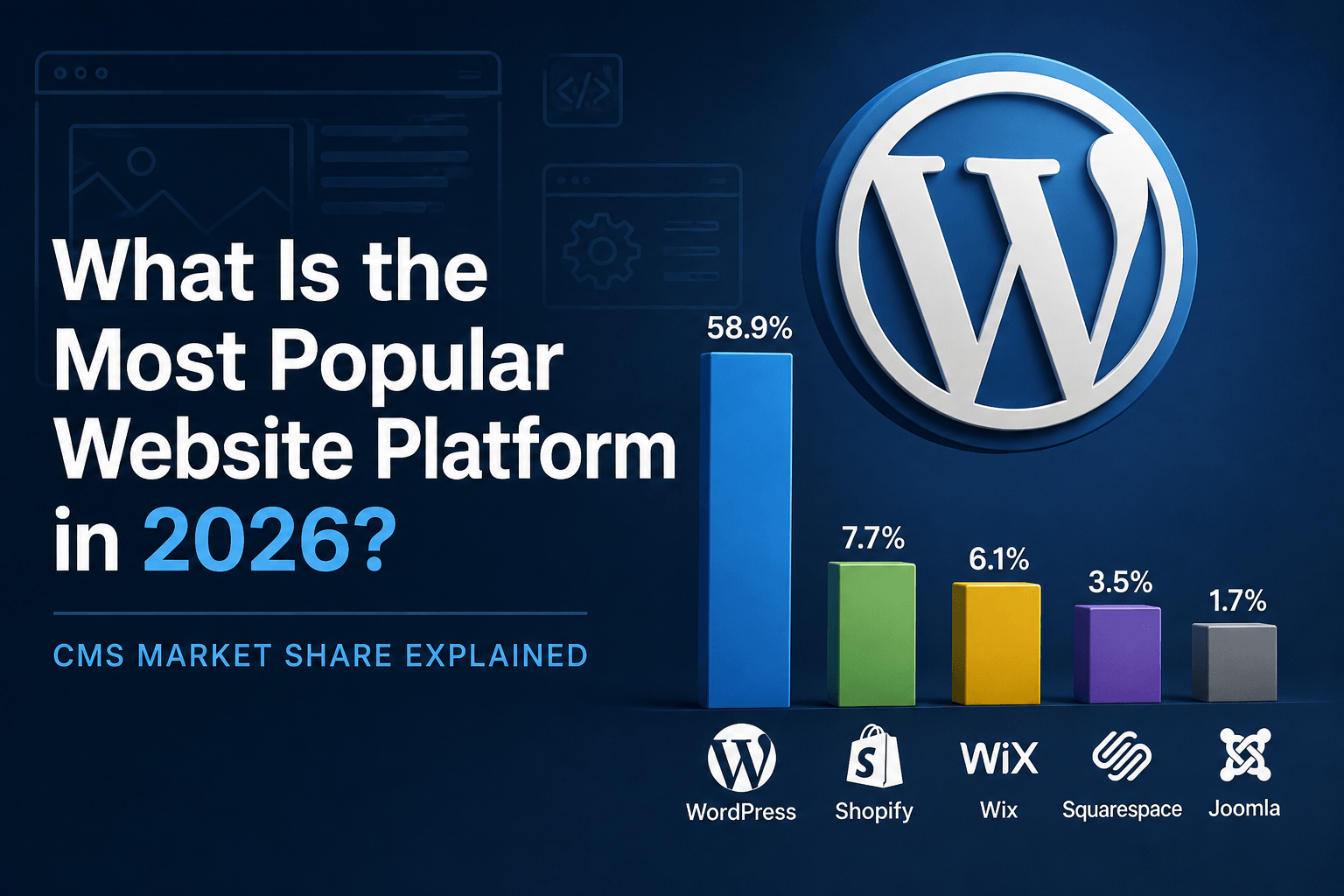
Current CMS market share figures from W3Techs put the leading platforms at approximately:1
| Platform | CMS Market Share |
|---|---|
| WordPress | 58.9% |
| Shopify | 7.7% |
| Wix | 6.1% |
| Squarespace | 3.5% |
| Joomla | 1.7% |
| Tilda | 1.2% |
| Webflow | 1.2% |
| Duda | 1.1% |
| Drupal | 1.0% |
That means WordPress isn’t simply the largest CMS.
Its market share is larger than Shopify, Wix, Squarespace, Joomla, Tilda, Webflow, Duda and Drupal combined.1
That’s quite a lead.
WordPress vs Wix
Wix has become an increasingly familiar name, particularly among individuals and small businesses wanting to build their own website.
However, the difference in usage remains substantial.
W3Techs reports approximately:
WordPress: 58.9% CMS market share
Wix: 6.1% CMS market share
Wix’s appeal is understandable. It provides an all-in-one hosted platform and makes it relatively easy to create a basic website without development experience.
WordPress offers a different proposition.
Rather than being tied to a single hosted website-building service, WordPress is open-source software that can be hosted, modified and extended independently.
For businesses planning to develop their website over several years, that flexibility can become particularly valuable.
WordPress vs Shopify
Shopify is currently WordPress’s closest competitor by CMS market share, with approximately 7.7% of the CMS market.
But this isn’t necessarily a like-for-like comparison.
Shopify is primarily an e-commerce platform, whereas WordPress can be used for everything from a simple five-page business website to publishing platforms, membership websites and complex web applications.
WordPress can also be transformed into a full e-commerce platform using WooCommerce.
The right option therefore depends on what the business actually needs.
For some online retailers, Shopify can be an excellent choice.
For businesses requiring greater control over their website, content, functionality and hosting, WordPress combined with WooCommerce can be extremely powerful.
WordPress isn’t just used for small websites
There’s sometimes a misconception that WordPress is primarily designed for small business websites and blogs.
The usage statistics tell a different story.
Among websites using a recognised CMS, W3Techs reports WordPress usage of approximately:1
- 49.3% of the top 1 million websites
- 51.4% of the top 100,000 websites
- 52.1% of the top 10,000 websites
- 47.3% of the top 1,000 websites
WordPress therefore isn’t simply popular because millions of small websites use it.
It continues to have a significant presence among some of the world’s higher-traffic websites too.
Why is WordPress so popular?
Market share alone doesn’t make a technology the right choice.
There are, however, several reasons WordPress has remained so widely used.
1. It’s open source
WordPress is released as open-source software.
That means you’re not restricted to one website company or hosting provider.
A WordPress website can be moved between compatible hosting providers, modified by another developer and extended with custom functionality.
For businesses, this can help reduce reliance on a single proprietary website platform.
2. It can grow with a business
A website might begin with five or ten pages.
Later, the same business might want to add:
- online payments
- appointment booking
- e-commerce
- customer portals
- integrations with external software
- quote calculators
- multilingual content
- custom forms
- API integrations
WordPress provides a strong foundation for adding functionality as requirements change.
3. There is a huge plugin ecosystem
The official WordPress Plugin Directory currently contains more than 71,000 free plugins.2
These can add everything from contact forms and SEO tools to e-commerce, caching, security and integrations.
Plugins aren’t always the answer, installing too many poorly chosen plugins can actually create performance and maintenance problems, but the ecosystem means developers rarely need to reinvent common functionality from scratch.
4. Thousands of themes are available
WordPress.org also lists more than 14,000 free themes.3
However, using WordPress doesn’t mean your website has to look like a template.
A professionally developed WordPress website can use a completely bespoke design while still benefiting from WordPress behind the scenes.
5. Businesses retain control of their data
This is one of the reasons I particularly like WordPress for business websites.
With a self-hosted WordPress installation, businesses can retain control over their website, database and content rather than having the entire website exist inside a proprietary website-building service.
WordPress itself highlights data ownership as one of the platform’s core benefits.
Does that mean WordPress is always the best choice?
No.
And that’s important.
There isn’t one website platform that is perfect for every project.
Shopify can be an excellent choice for certain e-commerce businesses.
A simple hosted website builder may be perfectly adequate for someone who wants to create a very small website themselves.
Other projects may be better suited to completely bespoke software or a specialist framework.
The important part is choosing the technology based on what the website needs to achieve, not simply choosing a platform because it’s popular.
However, for many small and medium-sized businesses, WordPress provides an excellent balance between ease of content management, flexibility, scalability and ownership.
The platform matters, but how it’s built matters more
There’s another important point hidden behind these statistics.
Simply using WordPress doesn’t automatically give you a good website.
Two websites can both run WordPress and have completely different levels of:
- performance
- security
- accessibility
- SEO
- usability
- design quality
- conversion optimisation
A poorly configured WordPress website loaded with unnecessary plugins can be slow and difficult to maintain.
A properly developed WordPress website can be extremely fast, flexible and straightforward to manage.
That’s why choosing the CMS should only be the beginning of the conversation.
The architecture, hosting, development, optimisation and ongoing maintenance matter just as much.
Looking for a professionally built WordPress website?
At Lucidflare Tech, I build WordPress websites for businesses that want more than an off-the-shelf website builder.
My approach focuses on creating websites that are fast, responsive, easy to manage and built with search visibility in mind, while giving businesses the flexibility to expand their website as they grow.
Whether you’re replacing an existing website or starting from scratch, I can help you work out what your website actually needs before deciding how it should be built.
Learn more about WordPress development
Explore web design and development services