
With Facebook, Instagram, TikTok and Google Business Profiles, it’s reasonable to ask whether a small business still needs its own website.
After all, if customers can find your telephone number, read reviews and send you a message through social media, why pay for a website?
For some very small or newly established businesses, social media can be enough to get started.
But relying entirely on third-party platforms has significant limitations.
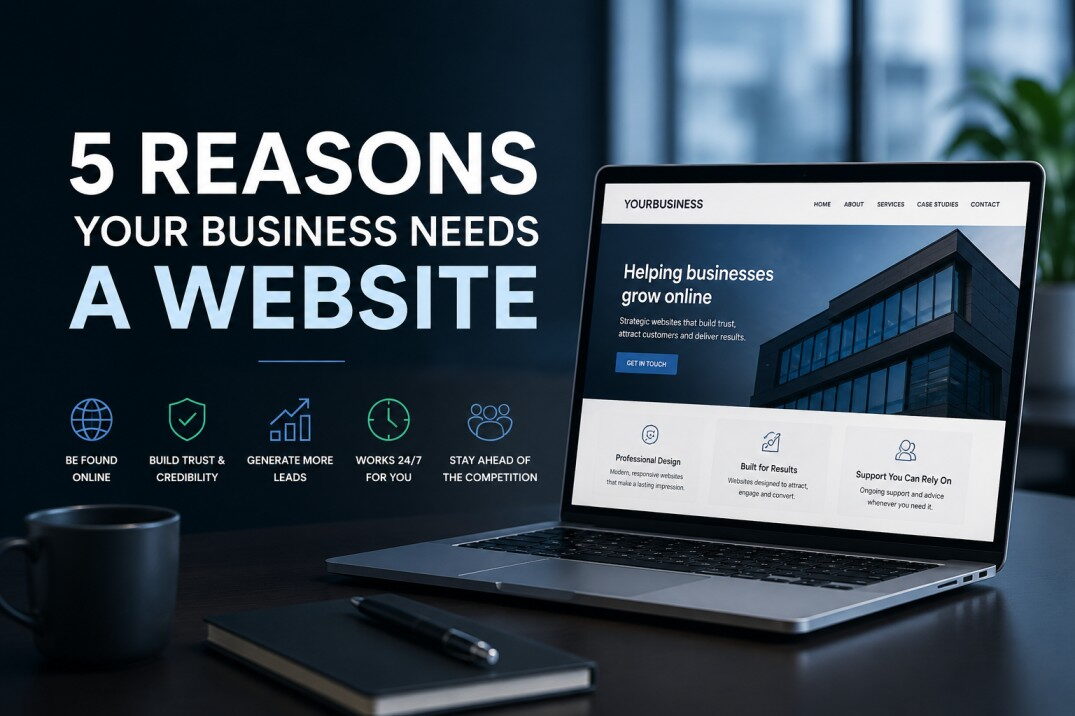
Here are five reasons I believe a professional website remains one of the most valuable digital assets a business can have.
1. Your website is something you control
Your Facebook page belongs to Facebook.
Your Instagram account operates on Instagram’s platform.
Your Google Business Profile exists within Google’s ecosystem.
Those platforms can be extremely valuable marketing tools, but ultimately you don’t control them.
Algorithms change. Features disappear. Accounts can be restricted. The amount of organic reach you receive can change dramatically.
Your website gives your business its own home online.
You control the content, structure, branding and customer journey.
Social media should complement that presence rather than necessarily replace it.
2. Customers expect established businesses to have one
Imagine you’re considering two local companies.
Both have excellent Google reviews.
One has a professional website explaining its services, showing previous projects, introducing the business and answering common questions.
The other has a Facebook page that hasn’t been updated for six months.
Which gives you greater confidence?
A good website provides somewhere to establish credibility before someone contacts you.
You can show:
- Customer testimonials
- Previous projects
- Qualifications or accreditations
- Your team
- Your process
- Frequently asked questions
- Pricing information
- Contact details
- Business location
For many customers, your website will form part of their first impression of the company.
3. It gives Google considerably more to work with
A Google Business Profile can help enormously with local visibility.
But there’s only so much information you can put on one.
A website allows you to create dedicated pages around the different services you provide.
For example, a company offering loft boarding, loft ladders and loft insulation can create genuinely useful pages explaining each individual service.
Google then has much more information with which to understand what that business does.
The same principle applies geographically.
If you genuinely serve particular areas and have useful information relevant to customers there, your website gives you the opportunity to demonstrate that.
A website doesn’t guarantee high Google rankings, but without one you’re limiting the amount of information Google can discover about your business.
4. Your website can generate enquiries while you’re doing something else
A website isn’t restricted to business hours.
A potential customer can discover your company at 10pm, understand what you offer, look at your work, read your reviews and submit an enquiry.
Depending on the business, a website can go considerably further.
It might allow customers to:
Request a quotation
Book an appointment
Buy a product
Check availability
Download information
Create an account
Make a payment
This is where a website starts becoming more than an online brochure.
It becomes part of how the business operates.
5. It makes your other marketing more valuable
Suppose you spend money on Google Ads, Facebook advertising, vehicle graphics, leaflets or even advertising on the side of a bus.
What happens when someone sees the business name and searches for it later?
Your website gives all of those marketing activities somewhere to lead.
It’s where somebody can go from:
“I’ve heard of that company.”
to:
“I understand what they do and I’m interested.”
This is also why simply having a website isn’t enough.
If advertising sends potential customers to a slow, confusing or outdated website, it can actively undermine the money being spent generating that traffic.
What about businesses that get all their work through Facebook?
If Facebook is generating plenty of business for you, that’s excellent.
I’m certainly not suggesting you stop using it.
I’d ask a different question:
How many potential customers aren’t finding you because Facebook is your only substantial online presence?
A website creates another route into the business.
Someone might discover you through Google, another website, an AI search service, a recommendation or an advertisement and then use your website to decide whether to contact you.
You don’t need to choose between social media and a website.
Ideally, they work together.
Does a small business need an expensive website?
No.
A local business doesn’t necessarily need a £10,000 website containing hundreds of pages.
It needs a website appropriate for what it’s trying to achieve.
For many small businesses, that means a relatively straightforward professional website explaining:
Who you are
What you do
Where you operate
Why customers should trust you
How they can contact you
Get those fundamentals right before worrying about complicated features.
Is it time your business had a proper website?
Lucidflare Tech designs and develops professional websites for businesses in Newcastle, Gateshead, across the North East and throughout the UK.
Our professional business websites currently start from £995, with straightforward pricing based on what your business actually needs.